Showing posts with label drama. Show all posts

Saturday, December 3, 2011

“The Dance Of A Lifetime” – Swan (manga) – 9/10 Snowballs


Ballet is a dance executed by the human soul. ~Alexander Pushkin

Mangaka: Kyoko Ariyoshi

Genre: Drama/Romance/Shoujo

Review Status: Incomplete (8 Volumes/21 Volumes) *Note- CMX only published 15 of the 21 volumes before folding, and there are no scanlations of the series.

Licensed: Formerly licensed by CMX manga.

Art: While this does have some strange holdovers of styles from the 70’s, this is classic shoujo art that manages to be straight-up beautiful most of the time. The usual sparkles-and-flowers that fill the pages of a lot of modern shoujo have never worked better than in this manga about ballet, where such things are a part of the stage and scenery. The mangaka also has a wonderful sense of motion and movement in her art that makes the scenes easy to visualize, which is especially important when creating a story where that’s so central to the plot. The realistic character designs convey the look of dancers on the stage beautifully.

Summary: Swan is the story of Masumi, a young girl from a rural Japanese town, who dreams of becoming a prima ballerina. She is picked to take part in a national ballet competition but realizes that although she has the passion and talent to be a great dancer, her training lags behind that of her peers. During the competition and the subsequent professional lessons, she fights to improve her abilities and achieve her dreams. (Amazon.com)

Review: Manga is something that is often subject to the changing styles and interests of the times. The art people like to look at changes, the things that society views as important changes, what people enjoy changes. What’s wonderful about this manga is that it manages to make a story that can withstand most of these things and create a story that’s still moving and engaging, much like Tezuka’s work still manages to be relevant and- above all- good.

This does show its age. The girls head out to a disco one night. They train in the USSR-named countries (though in the post-Cold War translation keeps the Cold War names of cities), 70’s fashions abound, but those aren’t intrusive or detrimental to the story at all.

Swan keeps is focus on one place only- the story of Masumi, a burgeoning ballet dancer who wants nothing more than to dance with the greats. With nothing but raw talent, she manages to make her way into some of the toughest ballet competitions in the world. Nothing is as easy as it appears, though. Her talent isn’t enough to win. She must train and study and work for hours on end, sacrificing time with friends and learning about herself and the characters she must portray on stage. It shows some of the most brutal things that ballet dancers go through. Becoming one is hard work and can destroy anyone who isn’t going to commit themselves 100%.

Masumi struggles with it herself. She doesn’t always win, she falls to competitive pressure, and it hits her hard when her friends find themselves in situations. Watching her grow as a character is fun and often touching. Her own growth is set off by and aided by a large and varied cast of characters that are as complex characters as Masumi herself. Things aren’t beds of roses for them, but they manage to pull through situations all the better for it. The nice thing is that these characters aren’t used as mere plot devices, to be seen once and never again. Often they are recurring characters that Masumi meets time and again, who grow and change themselves.

While this can get a little melodramatic, it doesn’t always detract from the manga. It’s about ballet, something that’s often seen as something that is melodramatic in and of itself. Swan keeps the struggles and issues of the characters pretty realistic to what real dancers go through. And the actual ballets can be gorgeously depicted. This has a charm and a strong story that manages to overcome any issues that come with being almost 40 years old.

Overall, this is one of the best shoujo manga around, and definitely worth a read if you like Princess Tutu or a good story.

Recommended: 11 and up. The ballet world isn’t always a nice one- there’s fierce competition, and when one dancer is injured in a way that might end her career permanently, she attempts suicide.

Other titles you might enjoy:
Glass Mask (anime and manga)
Cat Street (manga)
Princess Tutu (anime)

“Where Hope Begins” – My Last Day (anime) – 2/10 Snowballs


Going to church no more makes you a Christian than standing in a garage makes you a car. ~Garrison Keillor

Genre: Drama/Historical/Christian/Spiritual

Review Status: Complete (1 Episode/1 Episode)

Licensed: Yes, this is licensed in the US. It can be viewed legally on Youtube and other sites.

Art: This looks really good, with a great color palate and very lovely animation. Too bad it’s wasted on this.

Summary: The story of Jesus’ last day, as told through the eyes of one of the men he was crucified with.

Review: As I can tell you from my previous experience with the anime Steamboy, great visuals cannot translate into a good story. This anime is similarly troubled, with good visuals and a short runtime working for it, but everything else working strongly against it.

The biggest issue is that this adds absolutely nothing to the story. If you’re familiar with it, then there’s nothing in here that will give you insight or add a new dimension to Jesus’ death. Jesus is tortured, criminals and Jesus are crucified, Jesus and criminal go to heaven. The only way this might touch you is if you are familiar with the entire story that’s behind what’s happening, why this is such a big deal and what the implications of the storm and the cross and the burdens are- which are most definitely not told in this short.

So who exactly is this anime for? People who don’t know about Christianity? If the aim is conversion, then this is going to miss the mark completely, with the message “Believe in Jesus, because He is life insurance”. The only reason you should become a Christian is to go to heaven. Period. The only thing one should do to be Christian is to believe in Jesus. There’s nothing more to it, which, considering how big the Bible is with stuff that is not about Jesus’ death, seems to be missing the bigger point about being Christian- that you should also try to live like Jesus.

Part of the reason it suffers from such a shallow message is the way it chooses to tell the story. It chooses to dwell on Jesus’ suffering, all the blood and bruises and whatnot that He went through when He was tortured. It does not go into the ‘why’ of it at any point. When there is nothing meaningful to supplement the sight of people being whipped, beaten, and stabbed, then I call it as I see it- torture porn. If I wanted to watch torture porn, I would watch Hostel, where the violence is just as meaningless as presented here. Or even Passion of the Christ, which is just as soulless with the same material.

Having a non-traditional view of Christ’s death is an interesting, fresh idea that’s completely wasted. The only thing that comes from it is that you see what the criminal was convicted of in flashback. There’s no insight as to why he chooses to believe in Jesus or is moved by His suffering, nothing that would give theological meat to this bare-bones story. It almost hurts to know how much potential this had beyond the obvious message at the end.

Overall, this fails on every level to be a good representation of Christianity and is one of the worst choices in Christian entertainment you could make.

Recommended: Not unless you’re a Jesus completionist and must read and see everything about his life ever made. Other than that, 16+ due to the violence.

Other titles you might enjoy:
Blankets (graphic novel)
Jesus (movie- live action)
Jesus Christ: Superstar (movie- live action)

Saturday, November 26, 2011

“White World Around Us” – Shirahime-Syo (manga) – 6/10 Pumpkin Pies


Advice is like snow - the softer it falls, the longer it dwells upon, and the deeper in sinks into the mind. ~Samuel Taylor Coleridge

Genre: Drama/Fantasy/Historical

Review Status: Complete (1 Volume/1 Volume)

Licensed: No, this manga was formerly licensed by Tokyopop.

Art: This is pretty early CLAMP, with a familiar art style, but this looks like it was done all in ink paintings, which is very fitting for the setting of the story and adds an elegance to it that is quite enchanting.

Summary: Legends say that when it snows, it is because the snow princess is crying. From CLAMP, creators of Chobits and Cardcaptor Sakura, comes a collection of five tragic tales, all connected by the bond of snow. (back cover)

Review: This is where CLAMP decides to depart from their usual stories, and delves into a tribute to Japanese legends, giving them the traditional look and feel of folk tales you would hear growing up. The description is slightly misleading. There aren’t five tales- there are three, which are bookended by one story that isn’t really a story- it’s just some exposition and a moral. The exposition is nice, giving the introduction into tales of the Snow Princess and those who live in her domain.

The three tales start off with the weakest and end with the strongest. The first story- about a girl who sets out for revenge against a wolf- has some good atmosphere and character development, but fails to be that gripping or sorrowful. There is only a tenuous connection to the Snow Princess, which gives the last line a very out-of-place feeling that does nothing for the mood that it had built until then. The second, telling of two lovers who meet thirty years later- is definitely stronger and more tragic. A promise to never change is taken to quite an extreme, and makes it more poignant. The connection of the Snow Princess flows far better in this one. The third and best story of the three is where a man witnesses great love and is the instigator of great tragedy. This one does far better in connecting with the Snow Princess than the other two, and it’s downright tragic and beautiful. It’s unfortunate that the moralizing statement at the end of it has no bearing on what was happening in those stories and ruins the mood of the last tale.

With such a fuss made over the snow and the Snow Princess, I had expected more of this to be about her- instead, she acts as a side character in less than half of the volume. Even with that, the tales are still decent and have some deeply moving parts. When taken as it is, it’s a decent anthology of short stories.

Overall, while this would not be worth buying just to read it, this made a slightly better-than-average tragedy.

Recommended:
13+. This deals with themes of suicide and death. A few animals are shot, but there is only blood and no gore. Other than that, this is clean.

Other titles you might enjoy:

Watashitachi no Shiawase na Jikan (manga)
Nobody Can Hear Me But You (manga)
Solanin (manga)

Sunday, November 20, 2011

“Is There A Doctor In The House?” – Black Jack (manga) – 9/10 Pumpkin Pies


Nobody can go back and start a new beginning, but anyone can start today and make a new ending. ~Maria Robinson

Mangaka: Osamu Tezuka

Genre: Action/Drama/Medical/Shounen

Review Status: Incomplete (9 Volumes/17 Volumes)

Licensed: Yes, this manga is licensed in the US.

Art: This is Tezuka- very cartoonish, with round faces and exaggerated expressions. He will throw in visual gags with the panels or in faces, or even in background items. It’s easy to read and follow. The actual medical art is fairly detailed and anatomically accurate.

Summary: Black Jack is an "unregistered" doctor with a clouded, mysterious past. He works with his little assistant Pinoko (who has a massive crush on the doctor), dealing with medical cases not very well known, which can be strange, dangerous, or not known at all. But he is a genius, and can save almost any of his patients' lives (as long as they have the money for it, that is), and is known to many around the world, especially to those of medicine and science. He's a man of science himself, and does not believe much until he has seen it, yet it is many times he is surprised by love and nature often overpowering the science he bases his life in. (ANN.com)

Review: Black Jack- a man both sunned and reviled for his apparent unrivaled greed and lack of a license, yet admired for his God-like prowess with surgical tools, saving lives like nobody’s business, holding to a moral compass that’s nigh inscrutable and dealing out justice where he deems fit. He is part cowboy and vigilante in his dealings. Yet even with his skills, he cannot save everyone, either because it simply is their time or his patients have no desire to keep going, or even unfortunate accidents that prevent his cases from surviving. Each loss hurts him deeply, and fuels his need to be the best and keep working and to keep people alive.

This manga is more of an anthology of Black Jack’s cases. There is no particular running storyline, with Pinoko, the young teratoma-cum-girl the only thing that gives it any sense of time. Each volume seems to have a theme to it, one containing stories that mostly deal with how Black Jack is shunned by society, another that has various stories dealing with the will to live, and the thematic elements give it something interesting since Tezuka manages to deal with them in so many different ways.

Not only are the stories wonderfully created, with Tezuka dealing with morality and even the occasional theological question in captivating stories, but the characters manage to pull it off well. I admit to having no fondness for Pinoko, the often-annoying comedic relief, but Black Jack himself a man with many sides to him. His greed is tempered by his kindness, often receiving his ‘payment’ in forms that allow his poorer patients to breathe a sigh of relief. Those who are corrupt or evil will often find themselves at the mercy of some trickery or deception that leaves them in unfortunate predicaments.

Even when the stories focus on those he treats, there is often something compelling to their stories and their desperation. It’s easy to see why they are acting the way they do, and how Black Jack comes off to them- why he has the heartless reputation he does.

The only thing that irks me the slightest bit is how Black Jack is supposedly an unknown doctor except to the richest and most desperate. In virtually every story, though, somebody knows who he is, which flies in the face of that.

Overall, this is a fascinating medical drama that manages to show all the nuances of life, even in the face of death.

Recommended:
13+. There’s about one d-word per volume, and in the nine volumes I read, only three instances of any other language. No f-bombs. Patients do die, from old men to children. This deals with death in all its forms, from execution to suicide to congenital defects and diseases. The manga also holds a lot of medical information and procedures. Surgery of all sorts is performed, but is no more gruesome than a medical textbook. There is violence occasionally, with people being shot, crushed underneath beams, bitten by animals… if it can hurt you, it will appear in here.

Other titles you might enjoy:
Ode to Kirihito (manga)
Team Medical Dragon (manga)
Monster (anime and manga)

“Isn’t She a Doll?” – Dolls (manga) – 6/10 Pumpkin Pies


Yet for better or worse we love things that bear the marks of grime, soot, and weather, and we love the colors and the sheen that call to mind the past that made them. ~Junichiro Tanizaki

Mangaka: Yumiko Kawahara

Genre: Drama/Fantasy/Psychological/Shoujo

Review Status: Complete (4 Volumes/4 Volumes)

Licensed: Yes, this manga is licensed in the US.

Art: This has some lovely art, with lots of details and frills. It’s very shoujo in appearance, with lots of toning and shading.

Summary: Dolls are living plant life forms that look like beautiful women which can be purchased at a special shop for the right price. But be careful what you wish for. Set in an upside-down world combining a murky mix of science fiction, reality and moral ambiguity, Yumiko Kawahara's short stories examine the ineffable disparities that exist between the lover and the loved one. (Viz)

Review: Dolls choose who they belong to, and while the owners are charged incredibly large fees, they find themselves drawn- and sometimes repulsed- by the plants that behave as if they are alive. There are a number of different scenarios that occur, from discovering what happens when a Doll ages, to attempting to find a replacement for a dead child, to a Doll becoming the last will of a yakuza boss.

What this tries to do is get inside the minds of those people who are affected by them, the scenarios that occur when the Dolls are brought into their lives. However, most of the time the stories are completely unmemorable. They are too short to really get into any psychological fears or darkness, not only in number of pages but all the stories are stand-alone. There were a few that seemed to just start doing some wonderful things but were cut short due to time.

That’s not to say they were bad, just boring. A few of these did manage to stand above the crowd, though, such as that of the girl who told fortunes, and the man who was thought to be turning into a tree. Unfortunately, it was only when the story mainly focused on human characters and had the Dolls as a plot device that they were intriguing. Most of the ones that focused on the Dolls themselves fell short of being anything above average.

Overall, while this does present an interesting scenario, Petshop of Horrors did the psychological aspect far better.

Recommended: 12+. There’s virtually no language, no nudity, and no violence that I can recall. This does deal with some darker themes, such as the loss of loved ones.

Other titles you might enjoy:
Petshop of Horrors (manga)
Rozen Maiden (manga)

Friday, November 18, 2011

“Calling Out To You” – Voices of a Distant Star (manga) - 6/10 Pumpkin Pies


Absence diminishes small loves and increases great ones, as the wind blows out the candle and blows up the bonfire. ~Francois de la Rouchefoucauld

Mangaka: Makoto Shinkai and Sumomo Yumeka

Genre: Romance/Sci-fi/Drama/Mecha

Review Status: Complete (1 Volume/1 Volumes)

Licensed: No. this manga is not licensed in the US currently, but it was formerly licensed by Tokyopop.

Art: Light and sketch-like. There really isn’t solid shading, it’s mostly in shades of gray and done lightly. The character designs and layout are pretty solid and true to the anime.

Summary: To what distance would you go for your one true love? In the midst of an alien invasion, Mikako joins the resistance, leaving behind the one young man she loves. As she goes deeper into space, Mikako's only connection with her boyfriend is through cell-phone text messages. The war rages on and years pass, but Mikako barely ages in the timelessness of space while Noboru grows old. How can the love of two people, torn apart by war, survive? (Tokyopop)

Review: There are a few things that make a manga. One is the art and whether you can stand to look at it. The other two are the story and the characters, which combine to make something enjoyable. This manga mixed them in a way that leaves me with confused feelings.

On one hand, the characters and sentimentality this manga evokes are strong and moving. This manages to capture the longing for a loved one, impossibly far away, in a way that really speaks to anyone who has had to be far away from their own family and loved ones. Being away from them is hard in the first place- being away from them for years at a time, rarely in contact, and not knowing when you’ll ever see or speak to them is something else.

What mars that wonderful feeling of longing that is so exquisite in its presentation is the whole premise. People are randomly selected to be pilots of very large, expensive machines. The idea that any government, no matter how desperate, would throw people at random into these machines and then send them into a war zone is completely unbelievable. There’s no sign that there is some sort of shortage of people who are over the age of 18 and are smart, intelligent, and able to be pressed into service if it’s that desperately needed- one need only take a look at how Israel manages its army to see that it can and is done. However, it’s just taken as a matter of course for this lottery to exist.

Unfortunately, this means a lot of the feelings and sorrow I had were constantly interrupted by the thought that no government would ever do such a thing and made the whole storyline stupid and ridiculous.

Overall, suspension of disbelief is necessary to create a world that the reader can get lost in, and that failed hard in that respect, which ruined the emotion that the manga had.

Recommended: 10+. There are brief mentions of death- there is a war going on- but there is no language, no fanservice, and the worst there is in terms of gore are the burn scars on a victim of the attacks.

Other titles you might enjoy:
5 Centimeters Per Second (anime)
The Place Promised In Our Early Days (anime)
Children Who Chase Lost Voices From Deep Below (anime)
Saikano (anime)
Ef- A Tale Of Memories/A Tale of Melodies (anime)
The Girl Who Leapt Through Time (anime)

Monday, November 14, 2011

“You Can’t Return To The Past” – Return to the Labyrinth (OEL) – 6/10 Pumpkin Pies


No one saves us but ourselves. No one can and no one may. We ourselves must walk the path. ~Buddha

Mangaka: Jake T. Forbes

Genre: Adventure/Drama/Fantasy

Review Status: Complete (4 Volumes/4 Volumes)

Licensed: Unlicensed, formerly published by Tokyopop.

Art: This looks like a comic book rather than a manga. Occasionally the characters can look… off. Generally, it looks just fine, though.

Summary: 13 years after the events of the movie ‘Labyrinth’, Jareth is in need of a successor- and has chosen Toby! Stolen away to the Labyrinth, he must decide if he will take the crown, and Jared will once again try to win the woman he loves.

Review: I’m not sure whether my fondness for the movie makes me like this more, or makes me dislike it more. On one hand, all the characters that you loved are back! For brief cameos where they are utterly useless and might as well not exist. The romance between Jareth and Sarah? Almost non-existent. It is there, all right, but it’s a side story to what’s happening with Toby, and not really what fans are looking for.

I did like how this went more into the labyrinth, why it exists and the lands that surround it. There is no real depth to this, though, other than the small mentions of these lands, giving intriguing hints to how the labyrinth fits in. On the other hand, it disappoints in many ways, leaving questions unanswered as to why he left one woman and desired Sarah to begin with.

Many things rely on Deus Ex Machina in order to work, leaving character useless in the grand scheme of things, focusing on the person that we couldn’t care less about (he’s a bishie, but that’s all that’s in his favor), and plot threads go totally unanswered. One character and *major* plot thread all in one completely is forgotten about in the end so that some important moralizing can be tossed at the reader.

While it’s an interesting, more in-depth look at the world of the labyrinth, the story is completely lacking. As a Labyrinth fan, I am disappoint.

Overall, It was nice, but I’d suggest reading fanfiction instead if you’re looking for a romance fix.

Recommended: 10+. This could perhaps be lowered. If your kid is watching the movie, they can read this manga.

Other titles you might enjoy:
Alice in the Country of Hearts (manga)
Are You Alice? (manga)
Pandora Hearts (manga)
Karneval (manga)

“One-Eyed Man Is King” – Land of the Blindfolded (Manga) – 9/10 Pumpkin Pies


Every closed eye is not sleeping, and every open eye is not seeing. ~Bill Cosby

Mangaka: Sakura Tsukuba

Genre: Romance/Drama/Supernatural/School

Review Status: Complete (9 Volumes/9 Volumes)

Licensed: This was formerly licensed by CMX manga. They have gone under.

Art: It’s shoujo. Very typical shoujo art.

Summary: Kanade believes that most people go through life seeing with blindfolds on- they cannot see what will happen in the future or the past. Occasionally, her blindfold slips, allowing her to see somebody’s future. One day, she meets someone who’s blindfold came off long ago, who sees the past. Can their love work out, or do they see too much?

Review:
You would think that seeing the future or the past would be a good thing, right? You could see what the answers to a test were, or what had happened at great battles… but this manga shows that it comes with a downside. Kanade is scolded for getting in people’s ways (trying to keep them from getting run over), Arou is shunned for knowing things there’s no way he could have… She manages to keep a happy outlook on life while his has been one of sadness and misery. But when they meet, they connect over their abilities, and life gets better for both of them.

This manages to keep from being too outrageous. There’s no flying from buildings, no feats of astonishing foresight, these characters only see things that really could happen, from torn-up plants from a jealous friend, to a dog dying because it has been abandoned. Throw a third member in the mix that can see the future better than Kanade, and things get interesting!

I really like that they avoid the stereotypical love triangle. The main couple is the main couple, and while their relationship grows and matures, so does their friendships and other relationships. The revelation of their secrets brings about several awkward moments and misunderstandings, brilliantly told in how it’s not immediately accepted, and how it can go wrong when someone knows.

It does happen to go off the deep end at the end, with Arou’s power becoming so powerful that his life and existence is put at risk. Aside from that particular qualm, this is a sweet, lovely story about people who are a little different, but just want to help.

Overall, this is a great romance title, and definitely a good read.

Recommended: 12+. There is one scene where Arou sees back to Kanade undressing (by accident!) but you see nothing but her back. There is some innuendo, with words that sidestep around sex but never mention it, in one section of a later chapter. It will probably go over the heads of younger readers. Perhaps one use of the d-word. Arou’s mother falls off a cliff with another boy, but they are uninjured. The pasts and futures that they see are sometimes violent, even deadly, but these are only talked about.

Other titles you might enjoy:

Fruits Basket (manga)

Saturday, October 29, 2011

“A Time Of Healing” – Haibane Renmei (anime) – 10/10 Black Cats


There came a time when the risk to remain tight in the bud was more painful than the risk it took to blossom. ~Anaïs Nin

Genre: Slice-of-Life/Fantasy/Spiritual/Drama

Review Status: Complete (12 Episodes/12 Episodes)

Licensed: Yes, this anime is licensed in the US. However, it is out of print.

Art/Animation: The art is absolutely lovely, with backgrounds that seem to be watercolor, with vibrant colors and easily recognizable characters. The animation is also very good- it can easily stand up to the shows made today in many ways.

Dub Vs. Sub: While overall I prefer the dub because I feel that Rakka’s voice it too high-pitched and breathy in the dub, the dub is very good overall.

Summary: In a long-forgotten walled town, humans coexist with the Haibane, angelic-like beings of unknown origin. Rakka becomes the newest Haibane, after she awakens from a strange dream and finds herself hatching from a massive cocoon. With no memories of her previous life, Rakka struggles to adjust to her new surroundings, however burning questions remain in the back of her mind. What is Haibane and what is their purpose? What lies beyond the huge, forbidden town walls? Thus, Rakka begins her wistful journey of self-discovery and wonderment. (back of dvd cover of 1st volume)

Review:
Haibane is a stand-out series in every way. This takes an imaginary town and fills it with enough wonders and mystery to have spawned a thousand different theories on what the place is and what is happening both inside and outside the walls.

This starts out as a show that is about Rakka learning about the ways of the Haibane. She is introduced into the strange rituals that mark their lives, and how they interact and live with the humans in town. As she lives each day Rakka grows closer to the rest of the Haibane, each making their way into her heart. However, an event that emotionally destroys Rakka brings to light the purpose of this place and the reason the Haibane are there.

It’s clear that wherever this place is, it’s someplace that certain people go to where they die- those that are born as Haibane, that is, while humans provide them with friendship and things the Haibane need to survive. Those born as Haibane have something to atone for or overcome from their other life, and by being born here and living their lives, they have a chance to overcome it… or be drowned in their emotions and past.

Rakka’s emotional distress links to her cocoon dream, and both she and a friend are brought to the brink of destruction in turn. There are dark themes and things that run through both stories, and Rakka must find a way to bring herself out of darkness- and then save her friend.

Overall, this was a beautiful story of friendship and overcoming grief, with many themes that flow through it.

Recommended: 10+. There is no language, no nudity, and no violence, but a type of self-mutilation does occur, and it’s clear that at least one Haibane committed suicide. When Rakka’s wings sprout, blood does spurt, but it’s not a lot and the growth isn’t graphic.

Other titles you might enjoy:
Kino’s Journey (anime)
NieA Under Seven (anime)
Colorful (anime – movie, not the terrible series)
Yokohama Kaidashi Kikou (manga)
Angel’s Egg (anime)
Mushishi (anime and manga)

“Dream A Little Dream Of Me” – After School Nightmare (manga) – 9/10 Black Cats


People often say that this or that person has not yet found himself. But the self is not something one finds, it is something one creates. ~Thomas Szasz

Mangaka: Setona Mizushiro

Genre: Romance/Mystery/Drama/School/Supernatural/Psychological/Gender Bender/Fantasy

Review Status: Complete (10 Volumes/10 Volumes)

Licensed: Yes, this manga is licensed in the US.

Art: Lovely. The art is reminiscent of CLAMP’s style, with elongated limbs and some gorgeous bishies. The panels are clean and easy to read (the flow is great, too). Some of the choices in

Summary: You have just awakened to find your darkest secret revealed to a group of people who would do anything to destroy you: your classmates! That’s what happens to Ichijo Mashiro, whose elite school education turns into the most horrifying experience of his life when he’s enlisted to participate in an after-hours class. The only way for Mashiro to graduate is to enter into a nightmare world where his body and soul will be at the mercy of his worst enemies. Can Mashiro keep the life-long secret that he is not truly a “he” nor entirely a “she” – or will he finally be “outted” in the most humiliating way possible?

Review: First impressions are everything in the world, and Ichijo does the best to keep his the way he wants it- as a guy. This is harder than it seems when his top half is definitely masculine, but his bottom half is most definitely not! However, when he’s entered into a class where nightmares become reality and he must face the inner selves of himself and his classmates. The thing is, his inner fear/self happens to be himself… but with a girl’s uniform on, making him instantly recognizable to those who cross his path.

His classmates take an immediate interest- a girl that’s been broken by her abusive father and a rapist, a playboy that thinks Ichijo is the prettiest thing that he’s laid his eyes on but has inextricable ties to his sister, others that would use him as they saw fit. They all have their own demons to fight. Others come and go as they ‘graduate’, disappearing from the hearts and minds of their classmates. Some are unable to overcome their issues and merely disappear.

Watching Ichijo desperately try to figure out the feelings he has about his own identity and the romantic struggles and drama that occur while it happens is interesting, if slightly obvious by the third or fourth volume. I think most people will be able to guess what’s going to happen, and while that disappointed me because of how one of the wheels gets shunted aside, the fact that they’re able to overcome that and still be good friends who care for each other is something unique and wonderful in this genre. It also plays into them finding themselves and their inner strength.

The meaning behind needing to discover themselves and their strengths, as well as what’s happening in the school, managed to be a wonderful surprise twist. The inner struggle Ichijo goes through takes on a far greater significance, with the two sides to him perhaps not being as philosophical as suspected, and the need to graduate being more than just graduation. It all snowballs into one of the best romance/mysteries that I’ve come across in quite a while.

Overall, this was a very interesting look at the psyche and had a great twist I hadn’t expected!

Recommended: 18+. There is incest (blatantly stated but the act is merely implied). Sex is mentioned (and occurs. Genitalia is not shown and the few sections it was in were *brief* and I didn't think it was happening until I read comments that happened later. Kissing and the leadup to sex does occur. There is violence- people get slashed with swords, torn apart, dug into- but there is no gore and it's not graphic, though blood is shown. There are also a handful of minor swears.

Other titles you might enjoy:

I.S. Intersexuality (manga)
Wandering Son (anime and manga)
Revolutionary Girl Utena (anime)
Hour of the Mice (manga)
Arisa (manga)

Friday, October 28, 2011

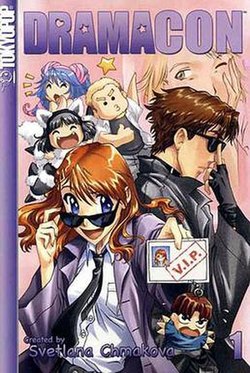
“Conventions of Love” – DramaCon (OEL) – 7/10 Black Cats


Love at first sight is often cured by a second look.
Love is sweet when it’s new, but sweeter when it’s true.
Love is like a butterfly, it settles upon you when you least expect it.
Love is the hardest habit to break, and the most difficult to satisfy.
~Drew Marrymore

Genre: Romance/Comedy/Drama

Review Status:
Complete (3 Volumes/3 Volumes)

Licensed: No. It was currently licensed by Tokoypop, but it isn’t any longer.

Art: Very good! All the characters are easily recongizeable, and very cute! The panels flow well, and the backgrounds are excellent.

Summary: When amateur writer Christie settles in the artist alley of her first ever anime convention, she sees it as an opportunity to promote the manga she had started with her artist boyfried. But when she unexpectedly falls for a mysterious cosplayer, things become complicated. What do you do when you love someone who is going to be miles away from you in just a couple of days?! (Back cover of the 1st volume)

Review:
This manga has earned a special place in my heart. An OEL manga about being an OEL mangaka gives a unique perspective on being a first time con goer (and all the interesting complications, drama, and surprises that come with it!), and the difficulties of making an OEL manga in the first place.

This covers all its bases very well and realistically. There were quite a few things that I enjoyed, from the mention of the men in skirts that don’t shave their legs, to how hard it is to break into the hardcore fans because it isn’t really ‘manga’ (which the author obviously has an opinion on, and I do have to sympathize with). This treats them with intelligence and humor, and I felt that in many ways these were the best parts of the manga.

The characters having to deal with all that on top of romance and family troubles is definitely something to behold! It’s hard not to love them, each one being such an individual. All of them are fully realized, and it’s wonderful to see their personalities bounce off of each other and create both chaos and chemistry.

However, the plot doesn’t quite live up to the brilliance that I expected from the hilarious first page. Most of it is quite good, really, from having to deal with security and other congers, getting recognized in the industry, the rough choice between going for your dreams with or without the support of a family that just doesn’t understand. Unfortunately, there’s two things that really bothered me. One was the choice of using attempted rape. Rape should never be used lightly, and that’s exactly how it comes across, both from the circumstances that precipitate it and in the aftermath of what happens to her and the boyfriend. The other is another obvious plot device to get one of the main characters and her mother closer together, used in a thousand dramas before this one.

These bring down what otherwise is a good story about the issues about romance that can happen at a convention. It really is good at tackling why it can be complicated- the distance that people live from each other, how it can be scary to actually take the step to keep in touch, the things that can happen between cons. Of course, a love triangle does happen- where Matt ends up getting together with another girl because… Well. Actually, that’s really never made clear, because it’s obvious that he really liked Christie and wasn’t really that into the other girl. This makes for a really awkward and heartbreaking situation for the other girl. She’s understandable jealous and hurt by how she’s just forgotten when it comes down to it.

All this means that some things are handled more smoothly than others, but in the end is a very decent story. Plot issues aside the romance was sweet (and sometimes bittersweet), while the situations are something that every con-goer (both those that aren’t in artists’ alley and those that are) are familiar with. It’s relatable, and accessible, for anyone who enjoys their conventions!

Overall, this was an interesting manga about the fandom and a touching manga about romance.

Recommended: 16+. There is attempted rape, almost-sex (thankfully no more than some kissing happens, though in one part they’re clearly nekked beneath the sheets). There is mention that Christine has had sex with her first boyfriend- and both she and her boyfriend are about 16 in the first volume). It’s also brought up between Matt’s ex and Christie. There’s also language- everything except the f-bomb makes an appearance about twice a volume.

Other titles you might enjoy:
Bakuman (anime and manga)
Genshiken (manga)
Fall in Love like a Comic! (manga)
Comic Party! (anime)
Doujin Work (manga)

“The Trials of Love” – The Color of Earth/Water/Heaven (manhwa) – 9/10 Black Cats


Do not regret growing older. It is a privilege denied to many. ~Author Unknown

Mangaka: Dong Hwa Kim

Genre: Slice-of-Life/Drama/Romance/Historical

Review Status
: Complete (3 Volumes/3 Volumes)

Licensed: Yes, this manga is licensed in the US

Art: The art might not be considered ‘pretty’- it’s really very plain, but it makes wonderful use of space in emphasizing things and making the story more expressive. Some of the panels are starkly beautiful. This uses a policy of ‘show, not tell’ to tell the story, and creates some of the most amazing scenes that convey a thousand things with a simple motion or expression. There is discretion and visual metaphor used when depicting openly sexual scenes. Whatever else it’s failings, the sheer skill it takes to do that is astounding and more than makes up for it.

Summary
: The Color of Earth tells of the daily lives and about the world of two generations of Korean women. Sometime in the past, in a quiet rural village of Namwon, Ehwa lives with her mother, a widowed tavern keeper. They are best friends and tell each other many secrets. As each spring passes she learns about her changing body and begins to learn about life. As Ehwa grows, her mother, left alone at young age, rediscovers love. As Ehwa grows, she also discovers love and must face a trial in order to be with him.

Review: “The Color of…” is a unique manga in a thousand ways. It is the only manga I have ever seen to deal with love and sex, and do it in a way that is both mature and sensitive. Using lyrical language that is full of similar and metaphor, each book tackles the different stages of growing up and maturing in a rural village in the late 19th Century/early 20th Century, and what it means to find love.

Each book separates Ehwa’s growth and maturation into sections, not defined by age so much as what happens at those ages. “The Color of Earth” begins with Ehwa discovering the differences between men and women, innocence leading to more than one misunderstanding (thinking that she’s deformed), and the men that frequent her mother’s inn casting her into confusion about the propriety between men and women. And as she discovers her first love, so her mother rediscovers love. This has a few rough edges concerning the story, but is fairly funny. The discussions she and her mother have are honest, and her mother introduces her to the simile and metaphor she herself uses to often speak of love (and other things, when Ehwa isn’t around). Ehwa discovers that there are some she cannot and should not love for various reasons, and learns of heatbreak.

The second book flows far better. Conversations flows far more smoothly, with much joking and teasing, which makes this a delight to read. It also becomes more in-depth when it comes to the body and sex. There’s a marked difference between the Ehwa of a few years ago, who crushed on the boys in her village, and the one who now longs for a man who will truly love her- she doesn’t waste her thoughts on guys who are only looking for a quick lay or are only messing around. This leads to a fateful meeting with a man that is serious about her- and in turn must leave her.

The third book is about Ehwa having discovered love, but dealing with the wait and heartbreak that comes with needing to wait for someone to return from a long journey. Because this takes place in an old time period, the wait seems long and is fraught with waiting and thoughts on what's happening. There is a change in Ehwa and her mother's relationship as she's is nearly a grown woman and her mother is aging. Ehwa does finally marry, and her mother's observations on watching her daughter leave hit home- beautiful thoughts that capture the essence of the loss of someone so dear. All the things that happened in the former books come together in a way that is just like real life- the culmination of experience and learning. And it's done in a way that is satisfying and beautiful.

Overall, even with a little bit of a rough start, this is a fantastic manhwa that tells a beautiful story.

Recommended: 18+. This is a story that deals with sex and sexuality- while the only genitalia overtly shown are those of young boys (briefly) and breasts on occasion, but there are suggestive gestures, blantantly sexual themes, and sex is shown (though it isn’t obscene in the context of the story. It actually comes across as something special and loving).

Other titles you might enjoy:
Usagi Drop
Solanin

Monday, October 17, 2011

“The Trials Of War “- Andromeda Stories (manga) – 5/10 Black Cats


On a large enough time line, the survival rate for everyone drops to zero. ~Chuck Palahniuk

Mangaka:Keiko Takemiya (art), Ryu Mitsuse (story)

Genre: Sci-fi/Action/Drama

Review Status: Complete (3 Volumes/3 Volumes)

Licensed: Yes, this manga is licensed in the US

Art: The art and character designs are kind of girly (pretty boys and large, sparkly eyes), with lots of sparkles and flowing hair to be found. It’s not bad, though- all the characters are pretty distinct and easy to recognize. And this particular art is pretty distinctive to this mangaka.

Summary: Cosmoralia’s Prince Ithaca is about to wed Princess Lilia of Ayodoya and be crowned Astralta III. The apparently favorable celestial bearings mean he will be no mere monarch but holy king of a new ‘papacy’. Alas, the peaceful inhabitants of Planet Astria have no clue that they’re next in line for invasion by a ruthless machine force- a threat that seems to metaphorize the inherent perils of politics and desire in this multilayered saga. (back cover of V. 1)

Review: An overlooked omen turns out to not be an omen at all- it’s the actual ship of machines that spell doom for the world. Twins are born as the country is slowly taken over, that are separated and one sent away in hopes of keeping a fight over the inheritance of the throne from occurring between them. However, as they grow, darker forces bring them together again.

This has a solid start, building the love between the queen and king of Cosmoralia, and how grave it would be if there were twins vying for the throne. Characters that are important are introduced. The beginning of the end takes root in the kingdom. And one twin is discovered to be the bearer or a mark that could signal the fulfillment of a vague prophecy.

From the second volume onward, things get a little shaky. Some plot threads are forgotten about, such as the mark and prophecy of one of the twins, others are brought in (the computers that can resist the temptations of the program that’s ravaging the planet) which have nothing done with them. The general plot remains solid, with the machines that invaded taking over bit by bit. To put it simply, ‘resistance is futile’. For everything the rebels do, the machines follow close after, destroying quickly and relentlessly. Machines can be made on assembly lines- humans can’t.

All the while, we’re seeing how the people deal with the effects of the extermination and following the stories of those who have been told that they’re destined to save the world and lead the humans to victory. It’s hard not to like them. Affle, who’s had his true identity suppressed for his own safety, is distrustful of others and does not welcome his brother with open arms. Slowly but surely, bonds grow, and it turns to strong feelings. Jimsa is more open to the prospect of a long-lost sibling, and is intrigued by his brother from the beginning. Going out of his way to protect Affle, he’s even willing to sacrifice himself as his feelings of love grow. Both are tossed about by the desires and ambitions of others but manage to take a stand for themselves as doom encroaches on them.

So how to save the world? Well, that would be spoiling it. However, I’m not fond of how the story kind of jumped the shark at the end. It decides to take a route that could have worked in other circumstances, but given the plot threads that were dropped or ignored, feels more like a cop-out. It also doesn’t really make any sense, which is even more of a shame.

Overall, this was an interesting premise but a bit of a letdown in execution.

Recommended: 16+. There is virtually no gore outside of the occasional body and bloodspill. The only thing that might cause some to pause is the implication of sex, a panel glimpse of boobs (important to revealing something plot-wise), and there is incest.

Other titles you might enjoy:

To Terra… (manga and anime)
Bokurano (anime and manga)
Historie (manga)
Cesare (manga)

Friday, October 14, 2011

“Trapped In Your Head” – Dragon Head (manga) – 10/10 Black Cats


All that is really necessary for survival of the fittest, it seems, is an interest in life, good, bad or peculiar. ~Grace Paley

Mangaka: Minetaro Mochizuki

Genre: Action/Mystery/Psychological/Drama/Horror

Review Status: Complete (10 Volumes/10 Volumes)

Licensed: No. It was formerly licensed by Tokyopop, but has not been relicensed.

Art: It’s a more realistic style than most, more like Satoshi Kon’s work than Studio Ghibli. In short- they look like people you could meet on the street.

Summary
: In the horror of witnessing so many classmates perish before his eyes in a violent train wreck, Teru discovers two survivors in the tunnel: Ako and Nobuo. But salvation from this bloody carnage is far from their grasp. As they try to dig out from the wreck in order to come up with a plan to stay alive, the lack of light and food, combined with the stench of death and decay, will lead one member of the group down a dark and demented path. And with sudden, violent earthquakes shaking the tunnel, escaping to the outside world may lead them to an even greater danger... (Tokyopop)

Review: When a disaster happens, sometimes what matters more is actually surviving instead of finding out what happened. In the aftermath of the crash, that’s the priority of the three survivors. However, trapped in a tunnel for days on end, they aren’t left with much to do except speculate and worry.

The first part of Dragon Head delves into the psychosis that can occur in extreme isolation, when people must face conditions not much different than sensory deprivation. Their fears become paranoia, that perhaps there’s something in the dark, or someone that survived but isn’t showing themselves. A monster eventually takes form in their minds, and between it and sudden changes that could spell their doom if they don’t think on their feet, two escape into a world that’s desperately changed and may never be the same.

Hard philosophical questions are asked, and none of the answers are easy and clear-cut. When is it okay to take a life? At what point do you stop helping others and start looking out for yourself? When do you stop searching for answers and accept the world around you?

The biggest challenge they have to face is the world outside. A disaster of unimaginable proportions has occurred that has flattened towns, raised huge ash clouds, and sunk the coasts into the sea. The disasters they face grow worse as they travel onward towards Tokyo. People have become crazed by the events, creating both allies and enemies to the pair.

When you think things can’t get worse for them, they can. They do. As Ako and Teru continue their journey to Tokyo, they deal with all the things the disaster can throw at them. Earthquakes, food and water shortages, flooding, death, and have to deal with it all when they’re still suffering from the psychological effects of being trapped underground and not knowing what had happened for two weeks. The not knowing becomes their drive- they need to know what happened to their families and what’s happening to Japan and gives them one of their reasons to survive. The other is their own fears that haunt them.

Overall, this is a moving, engaging story of two people trying to survive in an apocalyptic world. It may not be pretty, but it is pretty good.

Recommended:
18+. There are two brief instances of partial nudity on Ako’s part, one where she’s unconscious and being groped, another where she’s in a bath. You only see her breasts briefly. There is also the implication of her having been dry-humped, and two instances of attempted rape. This is very violent, with people committing suicide and murder. There are people shot, stabbed, and beaten. You only see one corpse more than once, but the wounds aren’t gruesome. For the rest of the story they’re usually covered in ash or mud.

Other titles you might enjoy
:
Drifting Classroom (manga)
Metro Survive (manga)
7Seeds (manga)
Akira (manga)
Jisatsu Circle (manga)
Doubt (manga)

Friday, October 7, 2011

“Apples And Oranges” – Fruits Basket (manga) – 10/10 Black Cats


It's surprising how many persons go through life without ever recognizing that their feelings toward other people are largely determined by their feelings toward themselves, and if you're not comfortable within yourself, you can't be comfortable with others. ~Sydney J. Harris

Mangaka: Natsuki Takaya

Genre: Romance/Comedy/Drama/Supernatural/Shoujo

Review Status: Complete (23 Volumes/23 Volumes)

Licensed: Formerly licensed by Tokyopop, it has not been relicensed yet.

Art: Somewhat generic character designs, but then again that might be because a lot of shoujo now take after FruBa as the model. Uncluttered panels that are easy to follow, with occasional heavy and blunt uses of toning.

Summary: Tohru Honda was an orphan with no place to go, until the mysterious Sohma family offered her a place to call home. Now, her ordinary high school life is turned upside down, as she's introduced to the Sohma's world of magical curses and family secrets. (Amazon.com description)

Review: This is a manga I avoided for the longest time simply because I wasn’t a fan of the anime. I deeply, deeply regret this now (and love my local library- yay for having the entire series at my fingertips!). There is a reason this is considered one of the best shoujo manga out there.

The first seven volumes consist of getting you introduced to the characters and the appearances of the Sohma family. This is what the anime covers. What comes after are the depths of the emotional instability and abuse that perpetuates within the household as the curse slowly unravels. At the heart of it is Akito and his relationship with his parents and the members of the Zodiac that keep him from venturing into the world and being true to himself.

Circling him are the members of the Zodiac, caught up in their forced love (and subsequent loathing) of their “God”. Akito manipulates and uses them to cure his own loneliness and self-hatred, while the parents of most of the Zodiac members fear and revile their children, leaving them with guilt and scars that they seek to heal in myriad ways. Tohru is caught up in it, with her love for Kyo and the others driving her to comfort them and befriend them, comforting them in any way she can.

Her journey in this world of conflicting roles and dark histories brings its weight to bear on her. When she finds that sometimes, there is nothing she can do, it starts making her feel that she could break. She Tohru goes from Mary-Sue-esque character to believable, real person in a heartbeat in this manga, and all the characters around her are as damaged but loveable- even the worst of them becomes sympathetic as the story unfolds.

There may not be any huge fights or adventure to distant lands, but this is nevertheless an epic story about people- coming together, moving on, and earning their happy endings.

Overall, this is a beautiful manga that deserves all the praise it gets.

Recommended: 15+. The language is really heavy in the first three volumes (Kyo has a mouth on him!) but rarely does it get worse than the d-word. There’s implied sexual relations between several characters.

Other titles you might enjoy:
Searching for the Full Moon (anime and manga)
Cat Street (manga)
Karakuri Odette (manga)

“In Memory Of” – Solanin (manga) – 9/10 Black Cats


There is a point in every young person's life when you realize that the youth that you've progressed through and graduate to some sort of adulthood is equally as messed up as where you're going. ~Jena Malone

Mangaka: Inio Asano

Genre: Slice-of-Life/Drama/Seinen

Review Status: Complete (2 Volumes/ 2 Volumes)

Licensed: Yes, this manga is licensed in the US

Art: This has fairly simple art, but while the panels are clean, easy to read and easy to follow, there is a very nice amount of detail in the characters and backgrounds.

Summary: When people hit college, they realize that they’re at a turning point in their life. What will they do for the rest of their time on Earth? It’s a time where it’s easy to get lost, lose sight of your dreams, and fall into a general funk. Meiko realizes that she’s fallen into this, and decides to try and figure out what she’s going to do by taking a few months off of work and thinking about it. Her live-in boyfriend supports her decision, and eventually she comes to support him and his friends as they are reinvigorated to follow their own dreams.

Review: Solanin. The name of a love song, a breakup song, a song that was dedicated to Meiko and remains Naruo’s favorite song that he wrote- the one that he and his friends decide to peg their dreams on when they get back together one last time to try and follow their dreams of making it big. It marks the complicated feelings they have toward eachother, but yet they love and support one another nonetheless.

More than anything else, this is a look into these two people’s lives. The trouble they have coming to terms with ‘adulthood’, realizing that we never stop growing up, learning that life is full of twists and turns, and how we love and remember people is one of the most important things in the world.

There is very little to not like about it. The humor is spot-on, the dialogue witty and honest, and considering that there are a billion clichéd movies about this same thing, fails to fall into that territory at every turn. This is a realistic look into life at what, for many, is an awkward age. It will resonate more with some than with others, but this is definitely a fabulous manga that everyone at that stage of life should read.

Overall, this is a manga for all those who feel a little lost in their lives. You are not alone.

Recommended: A mature 16+. There are maybe two swears, a little drinking/drunkenness. You get some brief partial nudity and implied sex.

Other titles you might enjoy:

Oyasumi Punpun (manga)
Beck (manga and anime)
Nana (manga and anime)
Our Happy Time (manga)
Ciguatera (manga)
Pumpkin and Mayonnaise (manga)

“In The Eye Of The Beholder” – Ode to Kirihito (manga) – 10/10 Black Cats


Life and death are one thread, the same line viewed from different sides. ~Lao Tzu

Mangaka: Osamu Tszuka

Genre: Drama/Psychological/Thriller

Review Status: Complete (4 Volumes/4 Volumes)

Licensed: Yes, this manga is licensed in the US

Art: Typical of Tezuka. The characters are far more cartoon-y than what you’ll find in most manga today, with some typical “older” touches to it- think those Mr. Magoo cartoons, and that’s what I’m talking about.

Summary: Kirihito Osanai is a young doctor who's just been introduced to the Monmow disease, which transforms humans into dog-like beasts and kills them within a month of the metamorphosis. While studying the pathology of the disease Kirihito himself becomes an unknowing guinea pig for his hospital's research into it. Under the auspices of research, Kirihito is sent to a remote village in the mountains, where he contracts the Monmow disease himself, and through a series of misfortunes, becomes estranged from his beautiful fiancée, Izumi Yoshinaga (the daughter of his hospital's Director and Chief Physician), and his close friend and rival, Urabe.

As the disease begins to transform Kirihito's body physically, the sudden metamorphosis impacts his character. Kirihito soon begins to doubt the medical world and after much resistance breaks down to accept his new role as a monster and spiritual figure in the quaint rural village he now lives in. Whether he is able to come to terms with his new life, however, it is certain that society will see him very differently. Quickly it becomes certain that Kirihito's life will be continuous strife dictated by the hospital that once employed him and is now looking to attain international acclaim by revealing the secrets (albiet incorrect) of Monmow's Disease.

It quickly becomes the secret mission of Urabe and Yoshinaga to find Kirihito and uncover the conspiracy and mystery behind this medical phenomenon, though Urabe seems to have motives of his own as pertains to the beautiful fiancée. Urabe, however, that is able to link the Monmow disease directly to water that runs from the mountain village where Kirihito is trapped, and the two doctors will independently discover the truth about Monmow. (Amazon.com description)

Review: Sometimes it’s really hard to sum up thoughts on a work. Ode to Kirihito is one of those ones. Kirihito is an honest, driven man, determined to not shake the boat too much. However, his honesty is a two-edged sword: When he goes against the hospital director and feels that he has discovered the true origin of Monmow disease, he is put in the sites of a man that will stop at nothing to support his theory and gain power and prestige from it.

You can tell what era this was written in. Osamu doesn’t shy away from showing the injustices that were perpetrated on people back then. There’s blatant prejudice and racism. At one point a character is nearly killed because she’s white, and (paraphrase) whites couldn’t catch a disease that until then had only been recorded in colored communities. Women are incredibly disenfranchised, with rape occurring several times simply because the man committing them was in love with them and ‘couldn’t control himself’. Sexuality plays a big part, from being used to oppress others to showing that even those who have differences aren’t all bad, as the racism works to show plays of power on the international stage.

It’s against this background that Kirihito must try and find a way to reveal the origins of the disease. He fights against ignorance and misinformation, and sometimes against simple blind hatred towards those who are different. Along the way he deals with the struggle of being considered less than human and the humiliation that comes with it, the question of whether it’s worth trying to survive in such unforgiving conditions, and whether he can actually succeed in his mission to avenge the woman he loved and find a way to right the misinformation the hospital director is trying to pass off as truth.

These questions are asked under the darkest of circumstances, from being used as a sideshow freak for a rich man, to finding a baby dying in the middle of a desert, to one of his companions dying in the dangerous way she lived her life. These events don’t exactly have happy endings. He might find the strength to move on, but they forever weigh heavily on his mind. Kirihito may have a measure of success at the end, but it comes at great cost.

There are definitely good guys and bad guys. Kirihito and most of his friends are sympathetic, dealing with deep flaws but ultimately being good people. The bad guys are mainly flawed, with few redeeming qualities, or what qualities they have dissolving under the need for power or under the pressure they face. It doesn’t make their stories less compelling. Actually, I feel it makes it moreso, as they overcome some obstacles but fail in others. They feel human, and utterly relatable in many ways. They make this story what it is- a brilliant work that showcases the effects of power and prejudice.

Overall, this is a moving manga about differences and revenge, and is a fascinating read.

Recommended: Adults only! People are killed in pretty terrible ways, from bombs and being shot to one instance of being fried alive. There is some gore- you see the wounds, the limbs, the bodies and blood spatter. It isn’t shy about the human body- there are several instances of almost complete nudity. There is also a lot of sexual imagery going on, from scenes of rape, attempted rape, and sex, or forced fellatiato. Thankfully the scenes are never completely graphic and often brief, with blackouts and symbolic pictures instead of being pornographic.

Other titles you might enjoy:

MW (manga)
Monster (anime and manga)

Tuesday, September 27, 2011

"Where The Heart Is” – Hanasaku Iroha (anime) – 7/10 Notebooks


The light is what guides you home, the warmth is what keeps you there. ~Ellie Rodriguez

Genre: Slice-of-life/Comedy/Drama/Romance/Seinen

Review Status: Complete (26 Episodes/26 Episodes)

Licensed: Yes, this anime is licensed for streaming on Crunchyroll.

Art/Animation:
PA works does a fabulous job. The colors are bright and light with more pastel-oriented colors. The animation is smooth and fluid and looks superb, especially during the opening song, which looks fabulous!

Dub Vs. Sub: There is no dub for this anime. The subs are a little inconsistent on spellings for names.

Summary: Hanasaku Iroha centers around 16-year-old Ohana Matsumae who moves from Tokyo to out in the country to live with her grandmother at an onsen ryokan named Kissuisō. While restarting her life there initially seems daunting, Ohana begins working at the inn, makes friends with the other employees and watches her life take an unexpected twist. (Crunchyroll official description)

Review: Ohana is in a tough spot. Her mom has decided to run off with a man, leaving her with no place to live and nothing to fall back on. While her mom’s thoughtlessness is nothing new, this time it’s above and beyond what she’s had to deal with. She sets out to a distant town, to a grandmother that she never knew about, to stay in the onsen. Little does she know that family ties have been severed, and she’s going to have to earn her keep and fest it up herself!

You get a good feel for the characters right off the bat, which is excellent- this is a show that depends on its characters to move the story forward. Ohana is a bit stubborn but kind, and genuinely wants to do a good job. Her friends seem typical stereotypes, with one a bit of a wilting flower (yay! Breaks out of the mold and has genuine love and talents for stuff!) and the other a tsundere. The rest of the cast are just as lively and interesting, though they exist mostly in the background. Over them looms thesadow of Madame Manager, Ohana’s grandmother, who started Kissuiso with her late husband.

Things start steamrolling from there. Ohana learns what it’s like to really work, making mistakes but discovering that there can be fun to be found helping people enjoy themselves. She makes friends with the granddaughter of a fellow onsen manager. Bits and pieces of family history fall into place about why she’s there and what the tension between Madame Manager and her son Enishin are. A confession of love from her friend Ko weighs on Ohana’s mind, as she tries to figure out whether she likes him back and whether a relationship can happen between them.

Up to episode 12, this had everything going for it. There was a solid cast, some beautiful episodes with learning to do duties, making friends, finding joy in work, and a suspenseful romance brewing in the background. About this episode, it hits a mid-series drag. Plotlines are conveniently forgotten about for some pointless filler, and the episodes just aren’t very interesting. Minchi goes from being slightly frustrating to downright obnoxious and annoying a number of times, and other characters that could have used the development don’t get it.

Thankfully, about episode 21, things pick up again. A romance that had been hinted at between Enishin and the woman he hired to improve Kisuissho’s image comes into full bloom, and the plotlines are picked back up to be resolved. Tension that’s been building between Minchi and Ohana, over a perceived crush that Tohru has on Ohana, comes to a boil. Ohana makes a decision concerning Ko. And Madame Manager comes to a decision concerning the future of the onsen that changes things for everyone.

Unfortunately, the epilogue could have been really good, but falls just on this side of average because of moments that were added simply to make the series more melodramatic. Everyone comes to decide that Ohana is taking Madame Manager’s side when she never clearly did any such thing. After a halfhearted speech by Enishin, everyone suddenly becomes just hunky-dory with letting the Ryokan go. One of the big plotlines, Ohana’s relationship with Ko, ends up being very badly handled all around.

I am pleased with the majority of the anime. It has wonderful moments, between the girls, between the staff, between family members, between the staff and the onsen itself. The characters are overall very likeable and fun to watch, and the things they have to deal with hit close to home (though some might be slightly exaggerated for anime’s sake). I would definitely watch it again sometime.

Overall, this is far from the worst title out there, and definitely has some wonderful moments in it!

Recommended: 16+. There’s no language that I can remember at all, no violence except for a brief tussle that Ohana and Minchi have (no punches are thrown, just a little wrestling- standing up). There is some slight "fanservice" in how the woman who tried to increase the onsens' popularity makes the girls wear somewhat skimpy dresses in one episode, while in another the girls go shopping for some clothes and one of the girls is a little... bustier than they thought (as someone who has dealt with that in real life, I actually sympathized and found the situation hilarious).

What drives the rating up is that one of the residents, a writer, writes…. Sketchy material. Unfortunately, this ends up with a lesbian scene between the three girls (purely imagined) that doesn’t go beyond innuendo and a scene in the baths where nothing shows but the shoulders, and Ohana helping him figure out how to tie some S&M knots (fully clothed, since she’s the one who gets tied up!). There are also a few scenes in the baths. The water covers everything, and the rest of the time the shots hide everything else- except in one scene where you see a little butt.

Other titles you might enjoy:
Ano Hana (anime)
Emma: A Victorian Romance (anime and manga)
Kobato (anime and manga)
Only Yesterday (anime)
Spirited Away (anime)
Ikoku Meiro no Croisée (anime)

Friday, September 23, 2011

“I, Android” – Karakuri Odette (manga) – 10/10 Notebooks


I believe that at the end of the century the use of words and the general educated opinion will have altered so much that one will be able to speak of machines thinking without expecting to be contradicted. ~Alan Turing, 1937

Genre: Sci-fi/School/Drama/Romance

Review Status: Complete (6 Volumes/6 Volumes)

Licensed: Not currently. It was formerly licensed by Tokyopop.

Art: For a shoujo, the art is surprisingly plain. Backgrounds of any sort are minimal. The characters can look awkward and gangly at times.

Summary: Odette is an android created by the young talented scientist Dr. Yoshizawa. Wanting to find the ultimate difference between humans and his android, Odette decides to persuade Dr. Yoshizawa to enroll her in a local high school. Follow Odette's adventures as she ventures through high school, in search of the true meaning of being a human. (amazon.com)

Review: The idea of an android wanting to be recognized or wanting to be like humans is a common one in science fiction. Manga isn’t very different. This shoujo takes advantage of the idea to approach the subject from the emotional standpoint of the android.

After watching a tv show, she gets the idea that it would be interesting to go to her high school and study humans. She makes friends by obeying her first directive- never to hurt a human. Odette is unusual in that she picks up most social cues very easily, figuring out what friends are and being accepting of everyone. This lands her in interesting situations, such as being a best friend (and potential love interest) of the school delinquent, and befriending other androids that weren’t made with the best of intentions.

Some of the interesting things are comparing how Odette grows and changes through the series in comparison to her companion android Chris. He ends up disappearing for a volume or two, and they are in such contrast with each other that it’s hard to believe that she was like he was a short while ago, or how ingrained she has become with her human friends. Of course, her uniqueness isn’t unnoticed by others.

A protective human guy friend (and potential love interest- but those who are going in for just that might be a tad disappointed by the ambiguous ending), an android that wants to marry her and have their parts mended, a jealous love triangle, and a scientist that only wants and values the best all end up complicating her life. Even so, friendship and family win the day. I think this ended exactly where it should have- a good note.

Overall, this was a sweet story about an android slowly becoming human.

Recommended
: 10+. There was one swear in the volumes I read, the d-word. Some of the robots are assassination robots, and in two chapters you see people disappear in a flash of light. Unless the idea of seeing robot parts scattered over the floor at other parts disturbs you, then this is a very safe read.

Other Titles You Might Enjoy:
Time of Eve (OVA and Movie)
Chobits (manga)
Absolute Boyfriend (manga)
Lovers Doll (manga)

Saturday, September 17, 2011

“Sweet Little Things” – Bunny Drop (anime) – 10/10 Notebooks


'Ohana' means family - no one gets left behind, and no one is ever forgotten. ~Chris Sanders and Dean DeBlois, Lilo & Stitch

Genre: Slice-of-life/Josei/Drama

Review Status: Complete (11 Episodes/11 Episodes)

Licensed:
Yes, this anime is licensed in the US, available for legal viewing on Crunchyroll

Art/Animation:
The art style stays true to the manga, with minimal detail and sketch-like art. That doesn’t detract from it at all! With vibrant colors and some beautifully fluid animation, this looks fantastic. The opening minute before the intro song is made to look like it’s done in watercolor, which adds a dream-like quality to it and really is pretty. Unfortunately, it goes back to standard coloring for the rest of the anime, but that’s not a bad thing.

Dub Vs. Sub:
There is no dub.

Summary:
While attending his grandfather's funeral, thirty-year-old bachelor Daikichi is surprised to discover that his grandfather had an illegitimate child with an unknown mother! The rest of his family, fearing the obligation and embarrassment, want nothing to do with the silent little girl, Rin. Sensing her imminent abandonment and outraged by his complacent family members, Daikichi decides to adopt her himself! ...yet he may have underestimated the difficulty of balancing his work, family, and love life with his role as her guardian.

Review: It’s hard not to compare this to the manga when I’ve read it and loved it. I was very scared when the anime was announced since I had no clue whether they’d be able to properly adapt it, or which parts were going to be adapted. This is the entire pre-timeskip half of the manga, covering volumes 1-3. It didn’t fail to deliver on any level!

The thing about anime is that it’s a completely different media than manga, and allowances have to be made for that. They did adapt everything, but expanded the stories in ways that enriched them. When Daikichi first meets Rin, the whole family is there, and certain rituals must be observed. The things that went on are expanded upon, really bringing you into the family dynamics and getting to know them.

This builds up the details of how Rin and Daikichi get along so well, showing the little things that go on in their everyday lives, the care that they have for another. What’s also nice is that two characters that I wish I saw more of in the manga- Kouki and his mom- get brought in a lot more often, and have a closer relationship than depicted in the manga. Some of the sweetest scenes were when all four were together, enjoying each other’s company like a family.

Not everything is sunshine and rainbows, though. Rin’s mom is alternately sympathetic and obnoxious. Rin and Daikichi do have some hard times explaining their relationship. They see how hard some things are for those around them and how love and family affects that. All these issues are handled well, in very sensitive ways.

To speak on how amazing this anime is, I know a few people who are dead-set about not having kids. This anime is *almost* enough to make them rethink that.

Overall, it’s a sweet story about two people becoming a family, and I hope that they pick up a second season.

Recommended: 10+. There are three swears, two d-word and one a-word. A trickle of blood from both Kouki and Rin’s mouths when they lose their teeth. However, this is very family-friendly, even though somehow I don’t think that kids younger than 10 would appreciate the subject matter.

Other titles you might enjoy:

Bunny Drop (manga)
Yotsuba&! (manga)
Love So Life (manga)